Dryer Cylinder
Dryer Cylinder
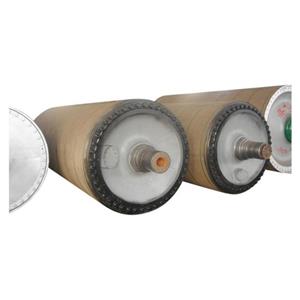
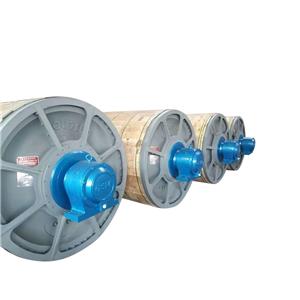
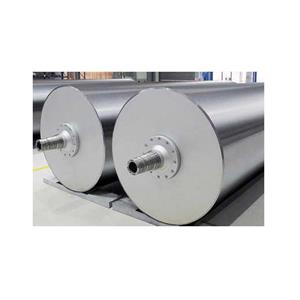
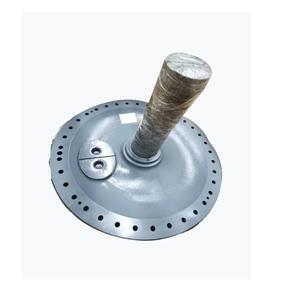
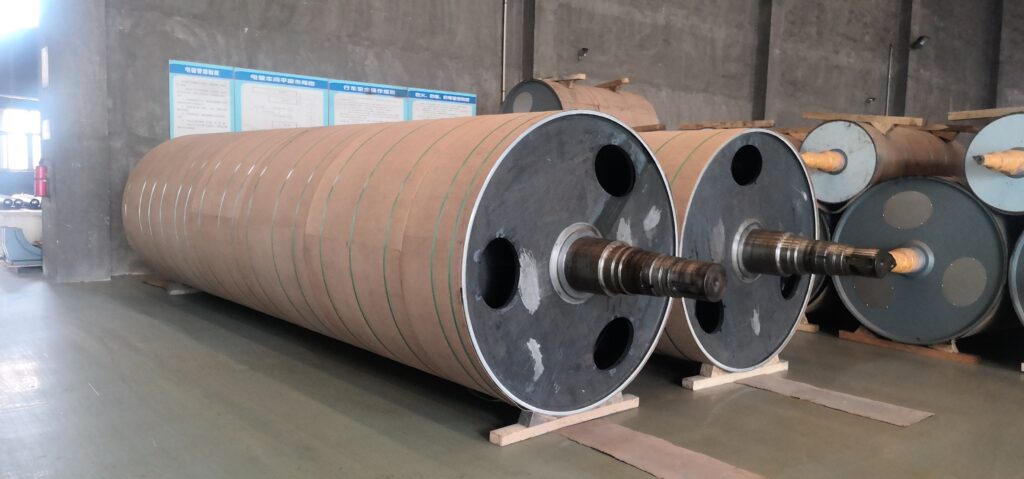
A dryer cylinder is a cylindrical body cast from iron with covers at both ends, primarily consisting of a cylindrical shell, end covers, steam joints, steam inlet pipes, and drainage syphon pipes.
Due to the increase in heating steam pressure, when the steam pressure exceeds 0.49 MPa (5 kg/cm²), steel dryer cylinders are often used.
Ordinary dryer cylinders are single-layer, while steel dryer cylinders may also have a double-layer structure.
After casting, the inner surface of the dryer cylinder is machined, and the outer surface is polished to a mirror finish.
Generally, dryer cylinders come in several diameters. According to the Chinese standard series,
The diameters are specified as: φ0.8 m, φ1.0 m, φ1.25 m, and φ1.5 m.
The shaft of the dryer cylinder is hollow, with steam pipes and condensate discharge pipes running inside the drive shaft.
The steam inlet pipe extends into the cylinder, positioned 0.8–1.0 m from the cylinder cover,
And is perforated along its sides and top to distribute steam evenly for heating the dryer cylinder.
Fabric Drying Cylinder
During the drying process, due to capillary action and condensation of water vapor passing through the dry fabric, the fabric contains a certain amount of moisture.
Therefore, a canvas drying cylinder is typically used to dry the fabric.
The structure of the canvas drying cylinder is the same as that of the paper drying cylinder,
except that it is not driven by a transmission system but rotates as the fabric moves over it.
After being heated by the drying cylinder, the temperature of the fabric increases by 12–18°C, reaching 75–90°C.
In recent years, hot-air fabric drying cylinders have also been adopted.
This type of fabric drying cylinder consists of a hollow cylindrical drum with perforated surfaces, having a diameter of 1.0–1.5 m.
The walls of the hollow cylinder are drilled with holes of 20–25 mm in diameter.
Hot air (90–100°C) is supplied to the drying cylinder at a pressure of 0.002–0.005 MPa (0.02–0.05 kg/cm²).
It passes through the perforated surface of the cylinder and then through the fabric running over it,
significantly improving the drying efficiency of the fabric.
With the adoption of dry fabrics, fabric drying cylinders may no longer be necessary.
They are retained only when canvas or needle-punched dry felts are used in the first group of dryer cylinders.
Cooling Cylinder
 Paper exiting the drying section typically has a moisture content of 4–6% and a temperature of 70–90°C.
Over-drying is detrimental to the calendering process, so a cooling cylinder is installed at the end of the drying section.
On one hand, it cools the paper (to 50–55°C), and on the other hand, it re-moistens the paper.
Cooling and re-moistening also help eliminate static electricity in the paper.
Generally, cooling cylinders can be positioned at the last two cylinders of the drying section to increase the moisture content on the wire side of the paper,
thereby improving the smoothness of the wire side after calendering.
The cooling cylinder is cooled by circulating cold water.
To prevent rusting of the iron surface, a copper sleeve can be added to the cylinder surface,
or a 2.0–2.5 mm layer of stainless steel can be applied through metal spraying.
Turbulator Bar
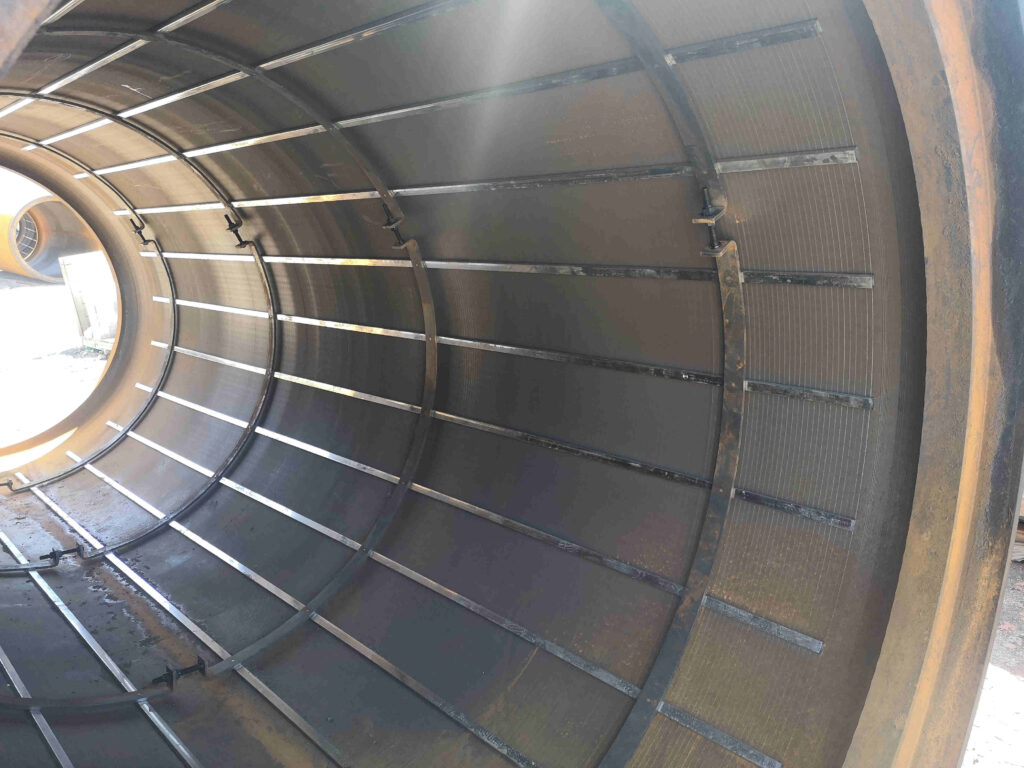 When a water ring forms inside the dryer cylinder, the condensate layer exhibits a relative oscillatory motion against the inner wall of the cylinder.
Observing a particle within the condensate water ring, it decelerates as it climbs to the top relative to the cylinder wall,
while during descent,it accelerates due to gravity, resulting in oscillation.
This oscillation aids heat transfer.
When the machine speed far exceeds the speed required to form a water ring, the oscillatory motion diminishes,
and heat transfer primarily occurs through a stationary water layer.
To improve the uniformity of moisture content across the paper width, short turbulator bars can be used.
These bars are installed in areas corresponding to the highest moisture content in the paper, helping to evenly distribute moisture during drying.
The use of turbulator bars can increase paper machine speed.
Dry Fabric Guiding and Tensioning Devices
To prevent the dry fabric from deviating, flexible guiding devices are required, similar to those in the wire and press sections.
Low-speed paper machines can use manual guiding devices to adjust the position of the dry fabric,
while high-speed paper machines require automatic guiding devices.
Dryer Cylinder Doctor Blades
To maintain the cleanliness of the dryer cylinder surface and prevent paper winding around the cylinder during web breaks,
doctor blades are typically installed on dryer cylinders.
Doctor blades are also essential on cooling cylinders and are preferably designed to oscillate to prevent localized wear on the cylinder surface,which could affect paper handling.
When doctor blades are installed on the upper row of dryer cylinders, a trough should be placed under the doctor blade holder.
Common materials for dryer cylinder doctor blades include nylon, polyurethane,
high-density polyethylene, phosphor bronze, and steel band saw blades.